

In the fast-paced world of SaaS, "everything" is a priority—but resources are always finite. At Quikest, we know that the difference between a market leader and a struggling app often comes down to sequencing.
Should you build the feature that 50% of your users want (RICE), or the one that prevents a massive "Cost of Delay" (WSJF)? Let’s dive into the technical comparison.
1. What is the RICE Score?
Developed by Intercom, the RICE score is a formula-based framework designed to minimize bias and maximize the "bang for your buck." It is highly effective for customer-centric SaaS teams. 🎯
The Formula:
$$RICE = \frac{Reach \times Impact \times Confidence}{Effort}$$
- Reach: How many people will this affect in a given timeframe (e.g., users per quarter)?
- Impact: How much will this contribute to your goal (Massive = 3x, High = 2x, etc.)? 💥
- Confidence: A percentage (100%, 80%, or 50%) to account for "gut feelings" vs. hard data. 🛡️
- Effort: The total time required from product, design, and engineering (measured in "person-months"). 🛠️
2. What is WSJF (Weighted Shortest Job First)?
WSJF is a cornerstone of the Scaled Agile Framework (SAFe). It is an economic model used to sequence jobs to produce the maximum economic benefit in the shortest time. 💰
The Formula:
$$WSJF = \frac{Cost\ of\ Delay}{Job\ Size}$$
To calculate the Cost of Delay, you sum three components:
- User-Business Value: Relative value to the customer or business. 💎
- Time Criticality: Is there a fixed deadline or a window of opportunity? ⏰
- Risk Reduction / Opportunity Enablement: Does this prevent a future disaster or open up new markets? 🛑
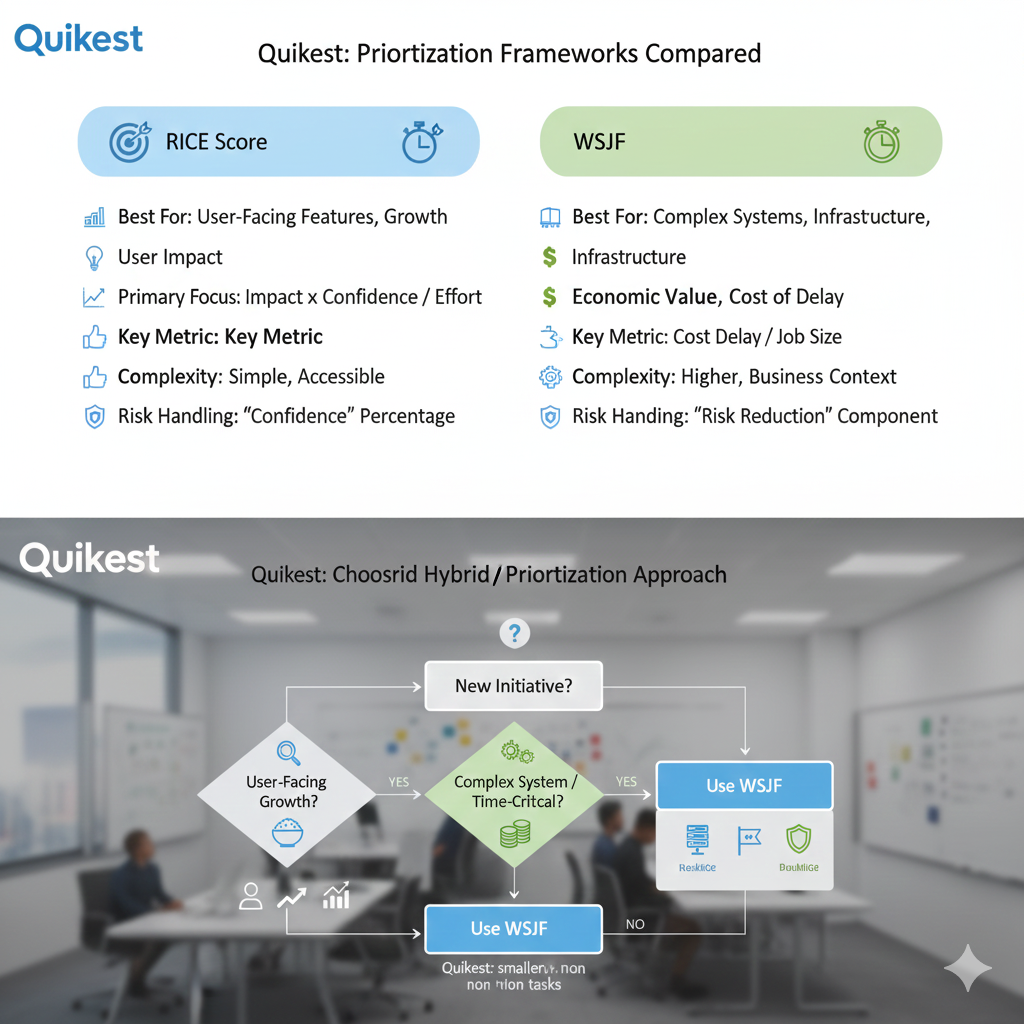
3. Key Differences at a Glance
Strategic Application and Focus
RICE is primarily designed for growth and customer-facing features, focusing on the broad impact a change will have on the user base. In contrast, WSJF is a more advanced tool often used in Agile frameworks for complex systems and infrastructure. Its primary lens is economic, centering on the "Cost of Delay"—essentially measuring the financial or strategic price of not doing a task immediately. 📉
Complexity and Risk Management
There is a notable difference in the barrier to entry for these models:
- RICE is praised for its simplicity, making it accessible for diverse stakeholders to understand and contribute to. It manages uncertainty through a "Confidence" percentage, which adjusts the score based on how much data supports the estimates. ✅
- WSJF requires a higher level of business context, as it demands a deeper understanding of time criticality and opportunity enablement. Instead of a general confidence score, it treats risk as a first-class citizen through its "Risk Reduction" component, rewarding tasks that eliminate technical or business unknowns. 🏗️
When to Use Which at Quikest?
Choose RICE if:
- You are in the growth stage and need to decide between multiple user-facing features. 🌱
- You have a data-rich environment where you can accurately estimate "Reach." 📈
- Your goal is to maximize Product-Led Growth (PLG). 🧩
Choose WSJF if:
- You are managing a large-scale enterprise SaaS with complex dependencies. 🏢
- Time-to-market is your biggest competitive threat (e.g., regulatory compliance). 🏁
- You need to justify technical debt or infrastructure work against new features. 🏗️

The Verdict
There is no "perfect" framework, only the one that fits your current lifecycle. At Quikest, we often recommend a hybrid approach: Use RICE for your feature experiments and WSJF for your strategic initiatives and platform stability. 🔄
By quantifying your roadmap, you move from "whoever shouts the loudest" to "whatever drives the most value." 💡